
A Giraffe is a Giraffe, Isn't It?
Last week during a group coaching session (even coaches have coaches), my coach asked us to do the closed-eye giraffe exercise. Yes, this is a thing: you close your eyes, draw a giraffe, answer some reflection questions, and supposedly have an aha moment.
I've run my share of workshops, I know how these exercises go. But I surprised myself by having a few aha moments. Surprised because I thought I knew myself pretty well by now. I consider myself someone who gathers all the details before starting something, and I always stress to my teams how important it is to define parameters up front before any design work begins.
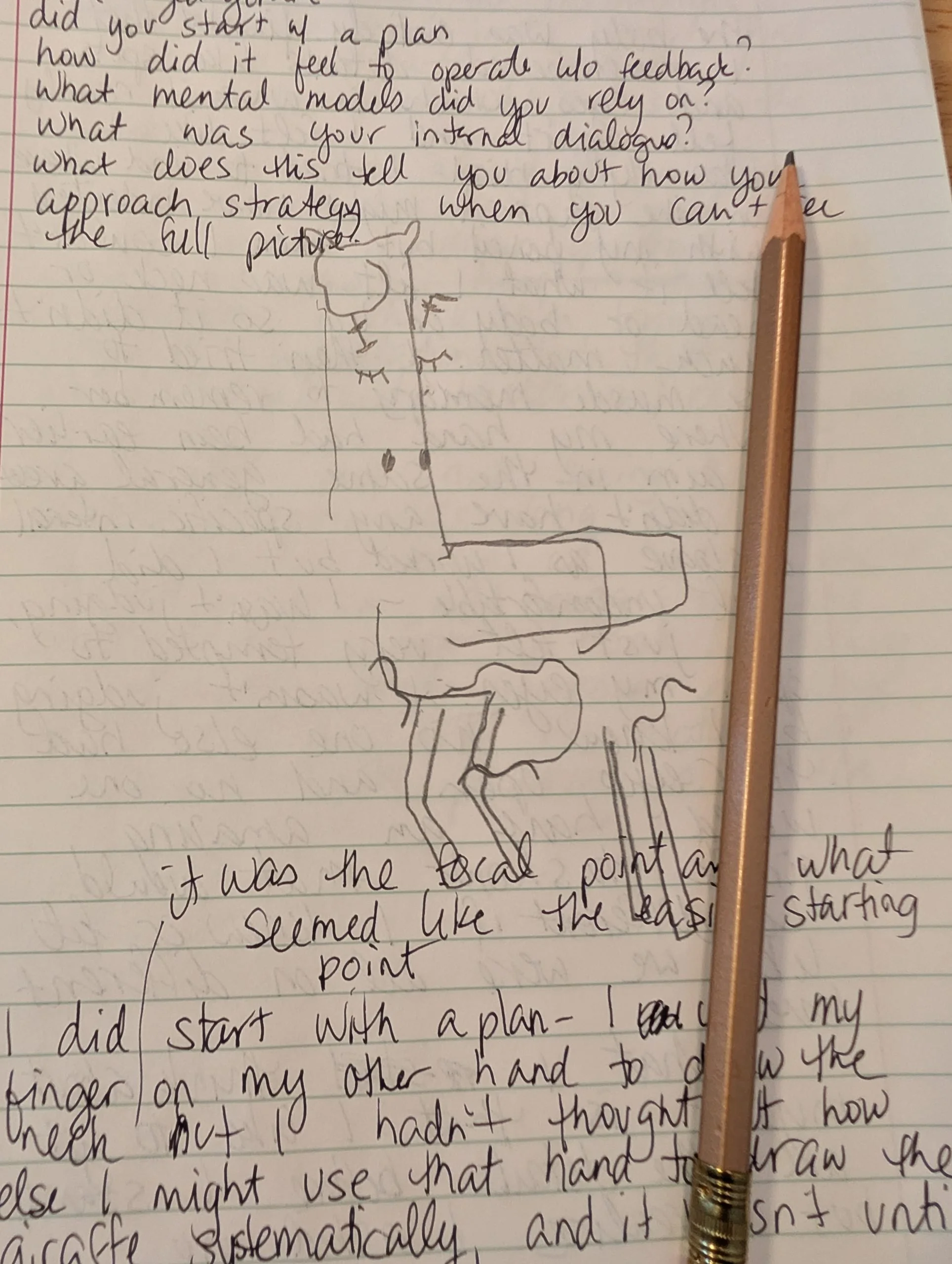
But when faced with the question in the exercise, “What does this tell you about how you approach strategy when you can't see the full picture?" I realized I didn’t do that. I didn’t seek out further details or ask for clarification. I took the instructions at face value and started going. Specifically because I already thought I had the full picture.
I already know what a giraffe looks like. Don’t I?
Let's put this back in the context of approaching strategy with my product partners. I'm certain I know what a giraffe looks like, but let’s say I'm actually picturing a gorilla. My PM also knows what a giraffe looks like, but she's picturing a hippo. The head of engineering is picturing an actual giraffe, but in explaining it to three engineers who just joined the team, only two picture a giraffe at all, and only one picks up that giraffes have ears.
What if everyone else did what I did, which is nod and smile and say, “Yes, yes giraffe” and go heads down to make our own giraffes? We all started working from what we knew to be true, assuming everyone else was seeing what we were seeing.
This is starting to sound familiar, I'll bet.
Often, teams don’t realize they’re all working in different directions until they come together for an update to find out no one is on the same page. You can't figure out why everyone is saying "giraffe" but no one has the same picture. The further down the road the work gets without alignment, the harder it is to untangle and the more time and money it costs to correct.
I’m not sharing anything earth-shattering here. This was probably less of an “aha” and more of a “gotcha” if I’m being honest. This shouldn’t be familiar because we shouldn’t keep finding ourselves falling into these patterns. We know better. So why aren’t we doing better?
So many times it’s because we think we already have the answer. One of my favorite takeaways from Adam Grant’s Think Again is “We favor feeling right over being right.” And in this case it didn’t occur to me to ask any clarifying questions, because I knew I was right about what a giraffe was. And yet, it wouldn’t have cost much time to ask for clarification or confirmation, "Just to be clear, we're drawing a giraffe—which has ears, spots, and a tail? Is it in any particular position? Do we need to draw foliage or just the animal?"
Are there questions I could have asked that would have changed the outcome of the giraffe exercise? Probably not in this case. I’m not great at drawing in the first place, so closing my eyes while drawing meant my giraffe was doomed from the start. But if I had asked those questions, any questions, I would not have panicked as I was using my other hand to measure my giraffe’s neck, wondering suddenly if that was against the rules. I would have better understood the parameters within which I could work, not just the what we were aiming for but the how we were allowed to get there. This is exactly how I encourage my team to work - and where I caught myself slipping.
As a UX leader, I coach my team to align with product and engineering not just on what the solution is, but what the requirements are. What time and tech obstacles can we not move? What must we include no matter what? Then where, within all of that, can we not only solve the problem but maybe sprinkle in something delightful?
Alignment like this takes time to set up, though. It requires initial coordination at the start of the work, and trust in and from our stakeholders to slow down just enough so we can speed up. And time and trust seem to be in very short supply these days.
Layered on to that is the manufactured urgency, amplified by AI, pushing us all to move faster to produce artifacts, to spit out something leaders can look at and click through. That pressure can make something like a project kickoff, specifically to gain alignment through collaboration and conversation, feel like a luxury we can’t afford. But if we don't all agree on what a giraffe is at the start, we're going to have a whole jungle to contend with down the road that will end up costing even more time, money, and quality.
So where does this leave us? I, for one, am checking my assumptions at the door. Even the ones about myself. I’m doubling down on asking questions, even if I’m confirming what I think I already know. I’m enlisting my fellow leaders to reframe project kickoffs and alignment conversations as necessary, not nice-to-haves, to protect the time needed for clarity. And the next time I draw a giraffe, my eyes will be wide open.