
tl;dr: Think Again by Adam Grant
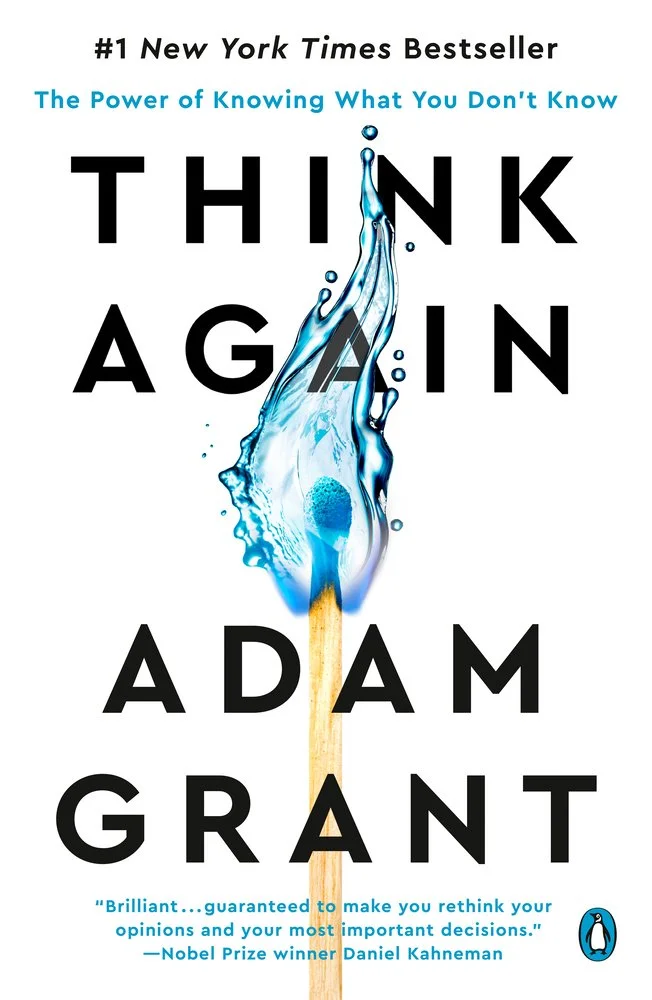
When I read, I underline the things I want to remember, then go back and write those down as my notes. I thought I would turn those into a series here called tl;dr. You can read my notes and thoughts and quotes from the book to get some great takeaways, or maybe you'll be inspired to pick it up once you get a taste. Either way, we're kicking it off with Adam Grant's "Think Again.*"
I'm an Adam Grant super fan. I've been fascinated with organizational psychology long before I knew it was a field of study (I was calling it the UX of People, but Org Psych sounds much more impressive), and the first time I heard Adam Grant interviewed, my flabbers were gasted. THAT'S IT! I thought, that’s what I’ve been thinking and talking about incessantly. So I dove into his books and podcasts. My first read and one of my favorites was Think Again. It really made me... wait for it... rethink my approach to my own ideas, as well as how I approached people who were clinging to their own ideas.
“Feeling right” costs more than being right.
I see this play out constantly in organizations, charging ahead with a reorg or rolling out a new process without the data to inform the change or success metrics because they think they already have all the answers. Being unwilling to check assumptions or be open to new information ends up costing the company trust and makes any changes less successful because of it. When companies, as Grant says, “…favor feeling right over being right" everyone suffers.
All Leaders need mentoring and coaching.
When learning stops at a certain level, or managers are made from tenure alone, how can leadership excellence be acknowledged when it wasn’t grown in the person doing the promoting? Grant frames it as: “When we lack the knowledge and skills to achieve excellence, we sometimes lack the knowledge and skills to judge excellence.” What does this mean for bad-fit leaders and the chain reaction of their decisions?
You get better by being challenged.
Get out of that echo chamber, y'all. At work. At home. Everywhere. You know what they say - if you're the smartest person in the room, you're in the wrong room. Adam Grant’s research says it this way: “We learn more from people who challenge our thought process than those who affirm our conclusions.”
The Confidence Comes From Doing.
Waiting until you feel ready or confident before taking on a challenge is doing it in the wrong order. Grant noted evidence that, “We don’t have to wait for our confidence to rise to achieve challenging goals. We can build it through achieving challenging goals.” Don't wait around to feel confident and then go kick some ass. Do it even though you're scared. Schedule that meeting. Hit send. Do the thing. You'll get better at it and more confident little by little.
Keeping Your Cool is Powerful.
It is a very frustrating reality that I've had supervisors who have yelled, insulted me, and pounded the table, then called me "emotional" or "insubordinate" the moment I raised my own voice. Adam Grant says that “When someone else is losing control, your tranquility is a sign of strength,” which was a reminder to myself that I give my power away when I meet others at their emotional lows. Or in other words, as George Bernard Shaw says, "I learned long ago never to wrestle with a pig. You get dirty, and besides, the pig likes it."
Performance Cultures Stifle Innovation.
For organizations to innovate, employees need to trust that mistakes will lead to learning opportunities instead of punishment, and that their peers and leaders hold themselves accountable for their actions. Those are pillars of psychological safety, the core of a strong learning culture. In a performance culture, though, people censor themselves around the "experts" and psychological safety is eroded. Adam Grant makes a powerful point that “Evidence shows that in learning cultures, organizations innovate more and make fewer mistakes.”
Debate Is Healthy.
In his book, Grant gives a great example of how to approach asking someone to rethink. "I understand the advantages of your recommendation. What are the disadvantages? How do you know?" I love this approach, and it made me wonder what I might do in the same scenario when faced with something I was holding on to strongly. I think it could open up a lot of excellent conversation and healthy debate, ultimately leading to better collaboration and solutions.
I could add another 20 to this list, easily. There's a lot in this book, not just for work, but for how we move through the world as citizens and interact with one another. If you're hesitant to read it, I'd implore you to think again (you knew that was coming).
*I’m a bookshop.org affiliate, which means if you purchase this book via this link, not only do I make a commission but you can also feel good knowing that bookshop.org gives more than 80% of their profit margin to bookstores.