
tl;dr: Radical Candor by Kim Scott
Radical Candor* by Kim Scott is one of my favorite books, and it gave me more than just advice on being candid in the workplace. Radical Candor helped me trust my own leadership instincts and put language to a leadership style I hadn’t fully articulated yet, in a workplace that wasn’t ready to hear it.

When I first read it, I was at a precarious place in my professional journey. I was starting a new role at a small company, and was feeling confident about my leadership abilities after coming off a prior role with lots of positive growth. What I didn’t know was that I was walking into a situation filled with miscommunication, unspoken expectations, and plenty of negative backchannel discussion that made it incredibly hard to land successfully. I had spent years learning how to be professionally candid, but was now surrounded by colleagues who met this approach with anger. I couldn’t understand it, and I was doubting myself at every turn; things I had done before that had been met with praise were suddenly considered unacceptable. I was having a Mugatu moment.
Radical Candor helped me to gut-check my sanity and articulate my leadership style to those around me, as well as identify areas where I still wanted to grow. I used this book as a reference guide for opportunities where, as a company, we could all learn to communicate more efficiently. I tried using what I learned in the reading in conversations. In the end, I wasn't able to move the needle, but it taught me a lot about the kind of leader I wanted to be, and the kind of environment I was willing to work in.
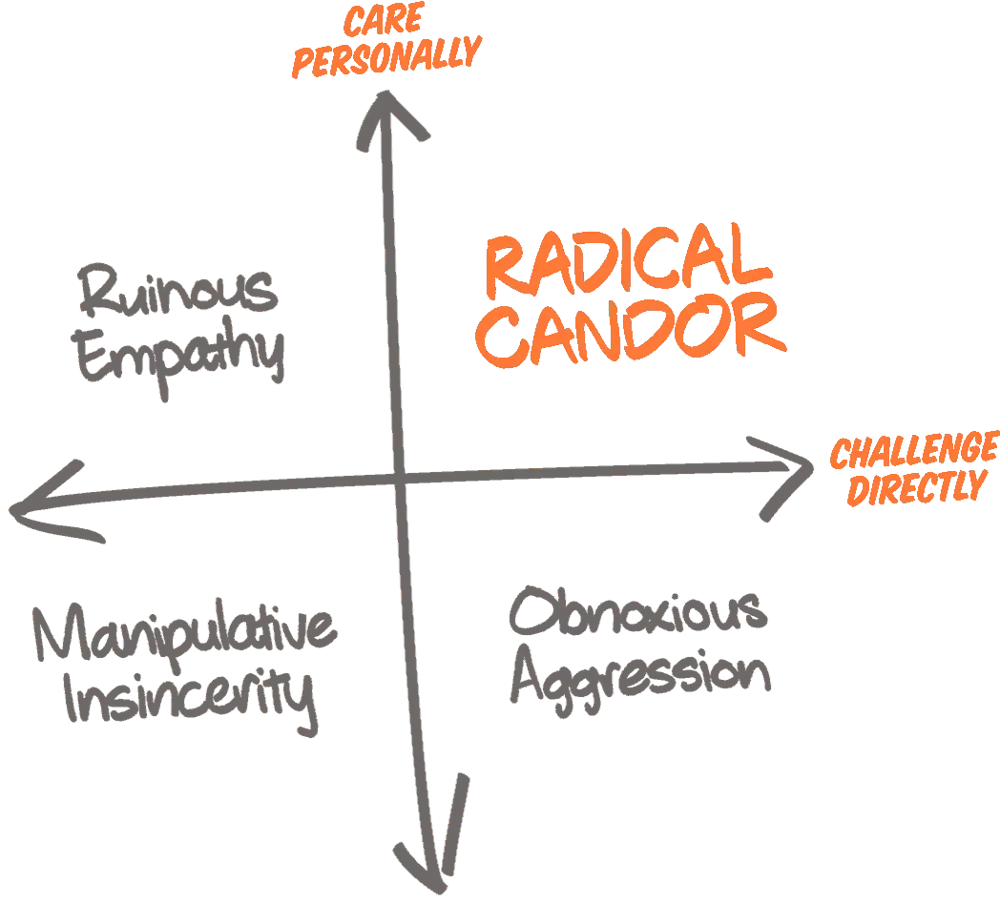
A lot of people who read it or teach from it talk about the candor and empathy chart, but I had some additional takeaways that aren't necessarily part of the "candor" messaging and still stick with me:
Lowering the bar is the real unkindness
In the book, Scott says, “...your job as the boss is to set and uphold a quality bar. ...in the long run, the only thing that is meaner is to lower the bar.” If you shift the job to fit where someone’s abilities currently are, you’re robbing them of the chance to stretch their skills, or identify that they aren’t a good fit and help them find a role that is. It’s also not honest to lower the bar, which is pretty unfair. The idea pairs well with Brené Brown's "Clear is kind.” and the idea that every second spent with the wrong fit is time not spent finding the right one.
Good Leaders Create the Conditions for Good Work
“You’re not getting good work out of people; you’re creating the conditions for them to bring it out in themselves.” This is where I have seen leaders fall down, and where I tend to find my leadership sweet spot. When I think about how I want to show up for my team, I think about my favorite managers and leaders: how they treated me, what behaviors they exhibited, and how it made me feel. I try to do those same things, adjusting as I go based on what I hear and sense from the team. I also remove myself from a lot of situations, creating the opportunity for the team to build and maintain connections with each other. I don’t see my role as demanding or pushing work out of them. Instead, we create a culture of psychological safety and collaboration together, and that leads to good work.
Culture is in the details
“When you pay attention to small details, it shows people your culture is worth understanding and adapting to.” Knowledge about your people shouldn’t only live in your head; it should be able to outlast you. When I was a manager, I started keeping an online notebook of details about each of my team members because I knew trying to memorize everything would be difficult to scale. Small things like their pets' names, favorite colors, and outside issues that occasionally pulled them away from work. It made it easier to plan gratitude and celebrations and build teams, but most importantly, I was able to hand that information to their new leaders when I left, enabling continuity in trust and partnership.
Innovation is more than a big idea
Every place I’ve worked has chased new, big ideas to keep up with the Joneses. But it’s rare that one good idea can rocket a company to the top and keep them there. Radical Candor references an HBR article that says, “A culture that captures thousands of small innovations can create benefits for customers that are impossible for competitors to imitate. One big idea is pretty easy to copy...” This was a huge DUH moment for me. It's easy to look over someone's shoulder and see what they're doing, but lots of small things add up and are much harder to reproduce. It's also a lot easier to pivot if one piece fails or meets an obstacle; if you have one big idea or innovation, it's a lot harder to shift as needs change.
Later on, I worked for a company that embraced Radical Candor as a formal training program for the entire company, including senior leadership. What made it work wasn’t the training itself, it was that leadership backed it with real structure and support for leaders at every level: standards that held, room for people to find their own answers, and systems that outlasted any one manager. In a way, Radical Candor isn’t just about candor, it’s about what you build around people so good work and good culture aren’t left to chance.
*I'm a bookshop.org affiliate, which means if you purchase this book via this link, not only do I make a commission but you can also feel good knowing that bookshop.org gives more than 80% of their profit margin to bookstores.